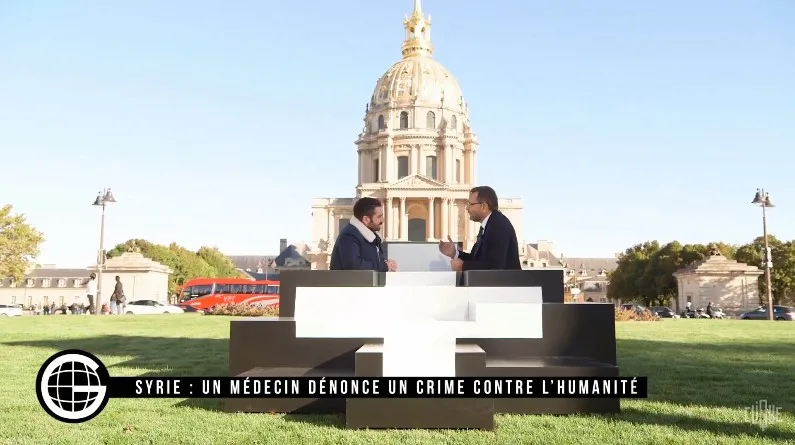
A poignant testimony from Aleppo
At the heart of the war in Syria, the city of Aleppo has become a death trap for 250,000 civilians, including 100,000 children. Under incessant bombardment by the Syrian and Russian air forces, hospitals have become priority targets. Ambulances lack fuel, and medical teams are themselves targeted. It is in this chaos that Dr Raphaël Pitti, emergency physician and former military doctor, decided to get involved.
He gives his testimony on the programme Le Gros Journal, where he describes the horror he lived through and denounces violations of humanitarian law.
When conscience speaks louder than fear
It all began when he heard on the radio the testimony of a French-Syrian doctor explaining that health workers were being arrested, tortured or killed simply for treating the wounded. Outraged, Raphaël Pitti contacted an NGO and left for Syria in 2012.
In a small hospital in Dana, 40 km from Aleppo, he experienced the horror of targeted strikes on medical facilities. After the wounded were evacuated, the facility was rendered unusable.
Why risk your life?
For this doctor, a man of faith, following his conscience is a duty: going where he is needed, despite the dangers. He is not answering a political imperative, but a deeply human necessity.
“My humanity is at stake in going to help them.”
A war manufactured by cynical alliances
Raphaël Pitti also denounces the responsibility of Western countries in the Syrian chaos. In his view, the initial support for the Syrian revolution was abandoned when it became long and costly. Saudi Arabia and Qatar, asked to support the rebels, funded Islamist groups. The result: groups such as Al-Nusra and Daesh emerged.
“We ourselves created this situation.”
As for Daesh, he considers the group to be an offshoot of the Assad regime, used to justify repression.
France is not at war, but must be prepared
Contrary to what some rhetoric suggests, France is not at war. However, the need for training in “life-saving skills” is very real:
- Using a tourniquet
- Placing someone in the recovery position
- Basic resuscitation in the event of haemorrhage
Simple but vital skills that can save lives in the first critical minutes.
The moral dilemmas of a war doctor
Raphaël Pitti also speaks of the ethical suffering tied to triage decisions: choosing who can be saved and who cannot. He shares a haunting memory: a dying little girl in Djibouti whom he could not save, for lack of resources and time.
“She is still here, with me. And I ask myself: could we have tried?”
Attacking a hospital: a crime against humanity
For him, bombing a hospital and killing doctors is not just a war crime — it is a crime against humanity. In Aleppo, 10 clandestine hospitals were targeted; only one remains. Vascular surgeons have disappeared, medicines are lacking, and amputation is the only option.
“A whole population is being killed, under the hypocritical gaze of the West and the Arab countries.”
Key points
- Aleppo is the symbol of a planned humanitarian catastrophe, with hospitals deliberately targeted.
- Dr Raphaël Pitti embodies committed, clear-sighted, deeply human war medicine.
- He calls for collective responsibility, an awakening of consciences and recognition of the crimes committed against civilians.
- His testimony, far from political debate, is that of a man who saves lives, even at the cost of his peace of mind.