A humanitarian commitment born of an ethical emergency
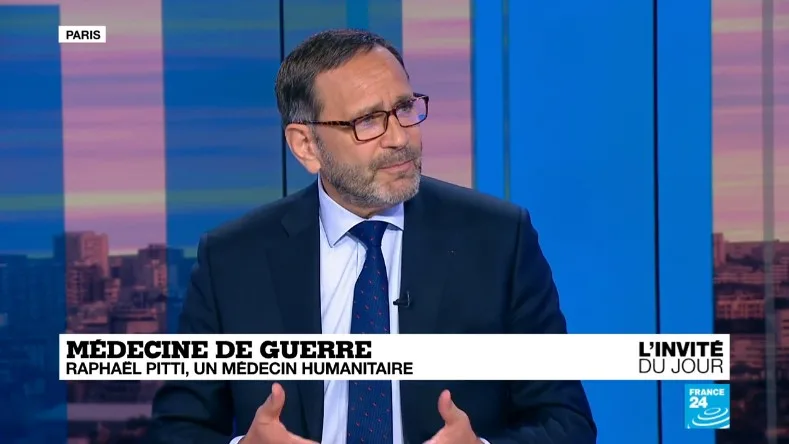
A former military doctor and now a humanitarian doctor, Raphaël Pitti, a guest on Paris Direct on France 24, has travelled to Syria some twenty times, often clandestinely. It was not chance that led him to this battered land, but a profound realisation one morning in 2012 while listening to the testimony of a Syrian colleague: “In Syria, health workers are killed for providing care.”
“Killing a health worker is an attack on our humanity.”
Faced with these violations of the fundamental principles of medicine, Dr Pitti felt the pressing need to act — not only by treating patients, but above all by training local health workers.
Teaching war medicine in the midst of chaos
From his first stay, Raphaël Pitti saw the extent of the disarray in field hospitals: Syrian doctors facing scenes of war without preparation, unable to triage the wounded, perform damage control procedures or respond to disaster situations.
With the Union of Medical Care and Relief Organizations (UOSSM), he set up a training centre in Syria to pass on the basics of emergency and war medicine.
Teaching adapted to the extreme
- Intensive three-day courses for health workers.
- Specific techniques: triage, haemorrhage management, war surgery.
- Courses on chemical threats.
- Creating a self-sustaining cycle: training the trainers.
Today, more than 12,000 Syrian health workers have been trained through this network.
Hospitals targeted, doctors hunted
The Syrian conflict stands out for an unprecedented form of violence: the systematic targeting of health facilities. Forced to flee traditional buildings, health workers organised themselves in clandestine basements, which were in turn targeted by Russian bunker-buster bombs.
“Never in modern history have hospitals been deliberately targeted in this way.”
This climate of terror aims to make all life impossible outside the areas controlled by the regime.
Chemical weapons as a strategic tool
Dr Pitti was among the first in France to raise the alarm over the use of chemical weapons in Syria. Rather than weapons of mass destruction, the Syrian regime used substances such as chlorine or napalm in small doses to drive fighters out of urban areas.
- Attacks with chemical grenades or shells.
- 187 documented cases of chlorine attacks since 2015.
- The aim: to break all rebel resistance and terrorise the population.
Thanks to a solid medical network on the ground, Raphaël Pitti’s team documents these attacks — medical reports, videos, data on symptoms — building reliable evidence.
A forgotten war, an inner struggle
The humanitarian doctor admits that Syria marked him more than any other theatre of war: the Balkans, Africa, Iraq… None left him with such a sense of loneliness and abandonment.
“So little would have been enough to save so many lives…”
The gap between the abundance of resources in France and the extreme precariousness of care in Syria shook him deeply, to the point that he left his hospital post in France to devote himself entirely to humanitarian work.
A faith anchored in hope
A practising Catholic, Raphaël Pitti says his faith has not been shaken, despite the horror he has seen on the ground. On the contrary, it is in hope in humankind, in its capacity to transcend itself for others, that he finds the strength to continue.
“The image of Christ giving his life for others is for me the ultimate example.”
A powerful testimony so that we do not forget
In his latest book, Va où l’humanité te porte (Éditions Tallandier), Professor Pitti shares his journey, his doubts and his commitments, and above all his unshakeable conviction that medicine is an act of resistance and humanity.