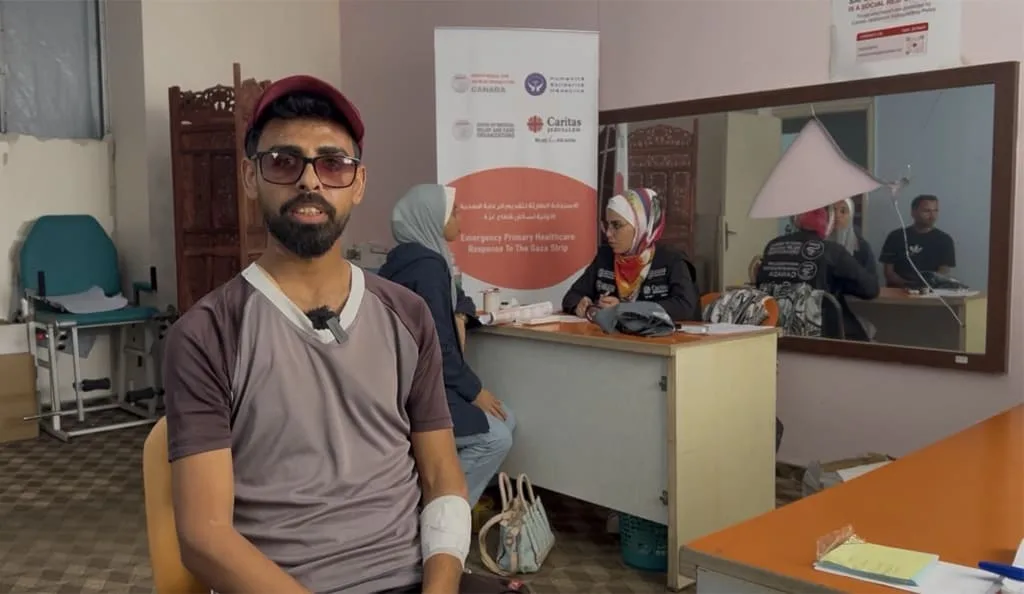
The war in the Gaza Strip is depriving thousands of civilians of vital care. Wesam’s story illustrates the crucial role of humanitarian health projects.
Wesam, a man from Jabalia (northern Gaza), was seriously injured in the chest and abdomen in a drone strike on a residential area. Rushed to the Indonesian Hospital, he unfortunately could not receive the care he needed. The overwhelmed facility, under an evacuation order, had to send him away without treatment, without a prescription and without medicines. Forced to flee with an open, untreated wound, he ended up in a makeshift shelter, with no medical supplies or professional help. In these conditions, he was at risk of severe infection, sepsis and other fatal complications.
When Wesam reached a field medical point run by HuSoMe, he was finally able to receive appropriate care. The doctors cleaned and dressed his wounds with sterile equipment, gave him antibiotics to prevent infection and prescribed painkillers to relieve his pain. Thanks to regular medical follow-up, his wounds gradually healed and his health improved markedly within a few weeks.
This intervention had a double impact: it saved Wesam’s life by preventing a potentially fatal infection, and it restored his confidence and dignity in a context of war and extreme suffering. Today, he continues his recovery and is still followed by our medical team, which cares for hundreds of other people in northern Gaza.
Wesam in his own words
“I was in so much pain that I thought I would die from this wound. No one could help me. Here, the doctors cleaned and dressed my wound. For the first time since I was injured, I felt safe.”
“Without this medical centre, I don’t know what would have happened to me. You treated me as a human being, not as a number. I will never forget this care.”
Support emergency care in Gaza!
Wesam’s story illustrates the reality lived by many civilians in Gaza and underlines the vital importance of an emergency medical response. Every intervention saves lives, reduces the risk of serious complications and restores the dignity of victims.
Supporting this kind of project gives injured and displaced people the chance to survive and rebuild their lives despite the war.