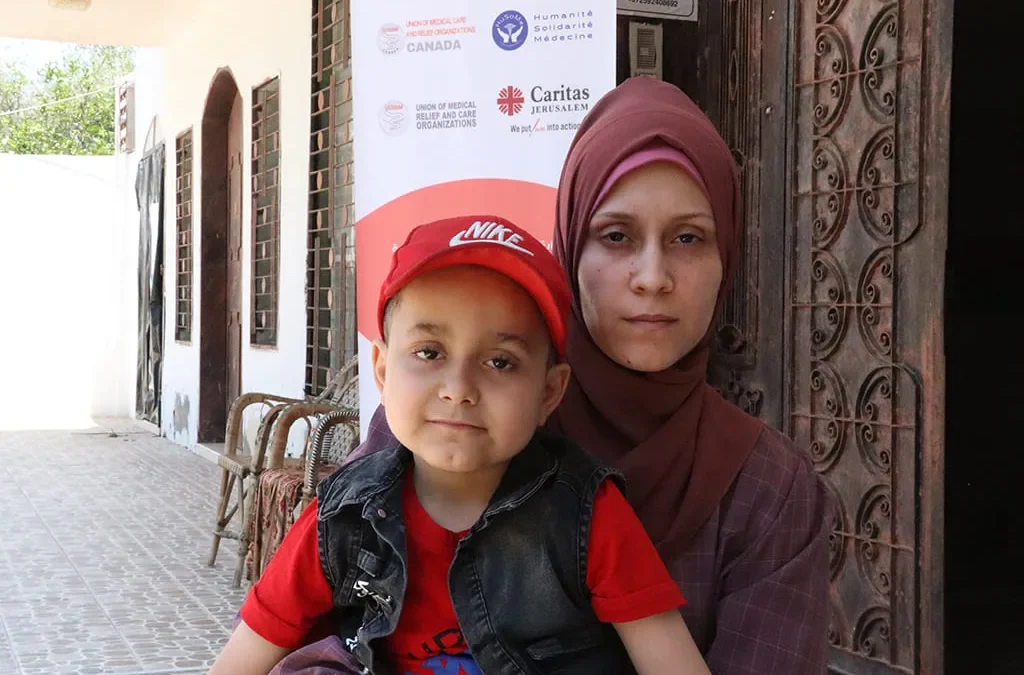
In Gaza, seven-year-old Mahmoud is trying to grow up in the midst of a war that has turned his childhood upside down. His unsteady gait, punctuated by repeated falls, bears witness to the daily struggle of a child with a neurological condition that has not yet been identified. Powerless, his family watched his difficulties worsen without being able to get any explanation. In overcrowded, ill-equipped hospitals, there was no answer amid the collapse of the health system.
A body weakened by illness and hunger
Mahmoud’s life is an accumulation of hardships. Stunted growth, pallor, thin hair, brittle nails: all signs of severe malnutrition, confirmed by anaemia. Iron, zinc and vitamin D deficiencies reflect the food insecurity affecting the children of Gaza.
On top of this came a persistent skin infection: recurrent scalp ringworm, with multiple lesions, itching and hair loss. For months, Mahmoud lived with these painful sores.
When care brings back hope!
Regular medical follow-up marked a turning point. Thanks to several oral and topical antifungal treatments, the skin infection was completely cleared. Oral supplements and nutritional advice partly improved his general condition.
For his family, this progress means hope:
“For a long time, we didn’t know what was wrong with Mahmoud. He kept falling when he walked and we had no way of understanding why. Now, at least, someone is helping us and following him.”
“Mahmoud had had painful sores on his head for months. After the treatment, they disappeared. We are very grateful: it’s the first time we’ve seen real improvement.”
A childhood marked by uncertainty
Despite these improvements, Mahmoud’s neurological condition remains undiagnosed. Brain imaging, metabolic tests and genetic analyses remain out of reach in a Gaza Strip where medical infrastructure has collapsed.
Every day, his future remains uncertain. His story illustrates the lack of specialised care that condemns thousands of children to suffer in silence.
A fragile symbol of hope
Mahmoud’s story is not an isolated one. It reflects the dramatic situation of a generation deprived of medical examinations and adequate nutrition. But it also shows that, even in wartime, appropriate medical follow-up can change a life.
Thanks to you, we can continue to provide care to this wounded and destitute population.